Rise of Nations Economy Guide
Factories, AI trade, policies, ideology tradeoffs, debt control, and river buffs.
In Rise of Nations, the treasury decides who can afford tanks, who can finish a formable, and who collapses mid-war. Hyperant’s Roblox grand strategy rewards players who treat factories and trade as the real early game. This economy guide explains factory types, consumer goods, selling to AI, the Ignore Safety Regulations plus Improve Infrastructure stack, Democracy tax versus Communism factories, debt danger, and 2026 river-city bonuses. Pair it with Getting Started for openings and the Military Guide once cash flow is stable. Browse all tutorials from the Guides Hub.
Why factories beat early city spam
Cities matter, but developing them before industry usually wastes the starting cash buffer. Factories convert inputs into high-value manufactured goods you sell on the market — especially to AI nations with population demand. Resource income from natural deposits helps, yet factory goods scale your early spike. Factory resource income is also capped per plant (community references often cite a high per-factory money ceiling), so building the right mix in high-population cores matters more than scattering weak plants everywhere.
Open the economy panel with E (see Controls) and plan builds on your richest cities first. Square cities with large populations generally host your best plants.
Factory roster: what each plant does
Electronics factories
Electronics are the early money king for many metas. Each electronics unit sells for a premium far above most raw resources. All-electronics openings (“greedy” four electronics) maximize AI trade if the market still has demand. The risk is ignoring steel and motors when a tank war starts next door.
Steel and motor factories
Steel and motors feed armored warfare and broader industry. A common tank-player line is one steel, one motor, and two electronics. Without steel and motors, your tank pipeline stalls and you pay more importing what rivals already produce at home.
Fertilizer factories
Fertilizer supports economic throughput and sits in the profitable manufactured tier behind consumer goods and electronics for many trade charts. Including one fertilizer in a five-factory policy-discount setup diversifies income when electronics demand softens.
Civilian (consumer goods) factories
Civilian plants produce consumer goods. They satisfy domestic demand, stabilize societies under tax pressure, and still sell surplus to AI. Skipping consumer goods to chase pure electronics often creates unrest and brittle tax income — you look rich on paper until stability events and war exhaustion arrive.
Aircraft and other advanced lines
Aircraft parts and later specialty plants matter once you contest air superiority or niche trades. Beginners should lock electronics, consumer, steel, motor, and fertilizer fundamentals before specializing.
Trade to AI nations
Human players negotiate, embargo, and betray. AI nations reliably buy manufactured goods up to population-driven demand. That is why building factories the moment intermission ends matters: every rival is racing for the same market share. Sell electronics and consumer goods aggressively, watch resource stockpiles so plants are not starved of inputs, and reopen trade routes after annexations so new cores feed the same machine.
If factories lack inputs they can run at severely reduced efficiency and may ignore positive factory-output modifiers — feed them or pause expansion.
Policies: Ignore Safety Regulations + Improve Infrastructure
Two early policies define strong openings:
- Improve Infrastructure — about -10% building cost
- Ignore Safety Regulations — about -20% building cost
Stacked, they deliver roughly -30% build cost, cutting a 25 million factory toward the high teens and often enabling a fifth plant from the starting treasury. A popular balanced five-plant line is one steel, one motor, one electronics, one fertilizer, and one civilian. Enact these policies before you spam builds; retroactive savings do not refund what you already paid.
Other economic laws (factory output spectrum, subsidization, industrial specialization) refine mid-game tradeoffs between extraction, manufacturing, and tax. Learn them after the first income spike.
Democracy tax versus Communism factories
Ideology is an economic lever, not just flavor.
- Democracy / Liberalism paths heavily buff tax income and help unrest tools, at the cost of weaker factory multipliers and slower justifications. High-population, service-oriented cores love tax metas.
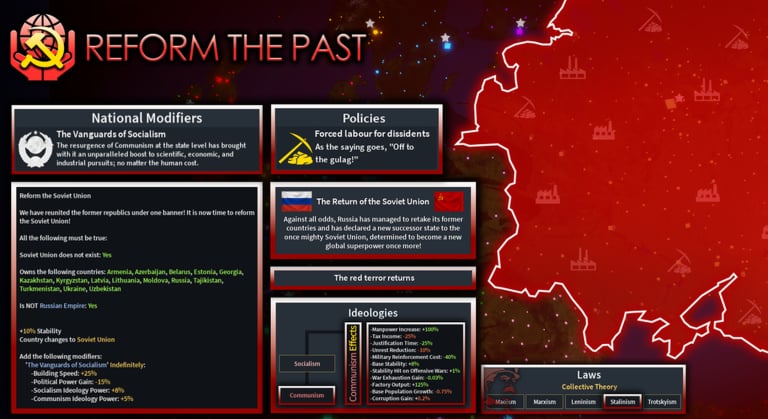
- Socialism / Communism paths smash factory output and resource output while cutting tax income. Resource-rich nations (Russia, many African starts, mineral powerhouses) convert Communism into absurd plant income once factories exist.
Pick the path that matches your geography. A barren tax-heavy democracy without factories underperforms; a Communism run without plants wastes the output multiplier. Political power and unrest gate safe ideology flips — do not coup yourself mid-deficit.
Debt danger
Debt looks like free money until interest and forced austerity gut military upkeep. Common debt spirals:
- Building too many tanks before electronics income arrives
- Max military spending with empty factories
- Losing trade partners after a botched war
- Ignoring consumer goods until unrest tanks tax
If income turns negative, pause recruitment, sell surplus resources, cut nonessential spending, and finish or white-peace wars that block recovery. Formables that require peace cannot be claimed while you are stuck in a losing conflict anyway — see Formables.
River city buffs (2026)
A 2026 map update added extensive rivers. Cities that rivers run through gain roughly 1.1x tax income, factory output, and resource output. Hydroelectric stations on rivers can supply core population and contribute toward a nationwide modifier that scales up to similar 1.1x economic bonuses. When choosing factory cities after this update, prefer river cores for compounding output. Technologies that mitigate river-crossing penalties help armies move across the new hydrology without turning every offensive into a slog.
Mid-game eco checklist
- Keep electronics and consumer goods online in top cities.
- Add steel and motors before major armored wars.
- Reinvest conquest loot into plants on newly integrated high-pop cores.
- Align ideology with tax versus factory strengths.
- Use river cities for premium factory slots.
- Watch factory input shortages and market saturation.
- Fund research that improves factory and resource output rather than only vanity techs.
Projects added in later updates (national factories and rail programs, economic stimulation, mining expansion, and related acts) offer longer investments of political power, money, and resources for lasting modifiers. Treat them as planned spends after the opening factory race, not replacements for it.
Linking eco to war and XP
A funded army with manpower reserves beats a larger broke army. Read the Military Guide for doctrines and unit composition once you can afford upkeep. Account-level progression still needs conquest and high XP modifiers — rich superpowers give poor XP rates — so review How to Get XP when grinding unlocks. Nation strength rankings live on the Tier List. Patch notes that retune factories or rivers appear on Updates.
Economy is the silent win condition in Rise of Nations: win the factory race, sell to AI, respect debt, and every other system becomes affordable.
Frequently Asked Questions
Quick answers players search for every session.
What are the best early factories in Rise of Nations?
Electronics and consumer goods lead early AI trade income. Add steel and motor plants if you expect tank wars, and fertilizer for a balanced five-factory policy-discount line.
How do Ignore Safety Regulations and Improve Infrastructure help?
Together they cut building costs by about 30%, often letting you afford five factories from the starting treasury instead of four.
Should I choose Democracy or Communism for money?
Democracy paths favor tax income; Communism paths favor factory and resource output. Match the ideology to whether your nation is tax-heavy or resource-and-plant heavy.
Why is debt so dangerous?
Debt interest and forced cutbacks destroy military upkeep and delay formables that require peace. Fix negative income before recruiting more divisions.
What changed with rivers in 2026?
River cities gain about 1.1x tax, factory, and resource output, and Hydroelectric Stations are river buildings that can add nationwide output modifiers. Prefer river cores for key factories. Full details: rivers update.
Where should I go after securing income?
Study the Military Guide and plan an early formable with Formables. Keep using Controls hotkeys to manage builds faster.