Rise of Nations Military Guide
Units, doctrines, entrenchment, rivers, AI tricks, and manpower for Hyperant's grand strategy.
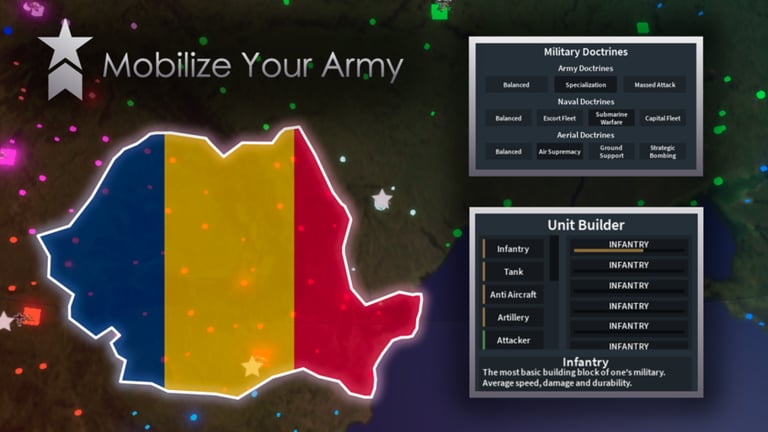
Wars in Rise of Nations are won by funded armies with the right doctrine, not by the biggest idle stack. This military guide covers land units (infantry, tanks, artillery, anti-air), navy and air roles, land doctrines including Static Lines, Massed Attack, Specialization, and Manoeuvre Warfare, plus entrenchment, auto-capture, the lure-AI trick, river crossings after August 2026, and manpower. Bankroll these systems with the Economy Guide before you max recruitment. Ideology and State Doctrine laws (including Stratocracy as a manpower law, not a land doctrine) are covered in Ideology. New players should finish Getting Started first; hotkeys are in Controls. All tutorials sit under the Guides Hub.
Land forces overview
Infantry
Infantry are the manpower sponge and late-game mass unit. Early on, raw infantry lose straight fights to tanks on open ground, but mountains, jungles, and heavy entrenchment flip the script. Anti-tank technology, cybernetic infantry lines, leaders, and defensive doctrines let infantry hold or delete armor later. Massed Attack style play leans into infantry spam; Specialization leans into elite terrain infantry; Static Lines leans into entrenched defense.
Tanks
Tanks dominate early and mid open-field wars: higher firepower, durability, and city capture efficiency than green infantry. They need steel, motors, oil logistics, and cash upkeep. Manoeuvre Warfare amplifies armored punches but can triple tank upkeep on deep trees — budget accordingly. Static Lines is often weak for pure early tank aggression because it nerfs mobility and offensive profiles relative to defensive buffs. After the River Update, tanks attacking across rivers fight at roughly 0.4x attack — path same-bank engagements whenever you can.
Artillery
Artillery softens fortified and entrenched positions so tanks and infantry do not suicide into Static Lines stacks. Bring guns to sieges; do not expect artillery alone to hold a front. Pair with scouting so you are not shelling empty tiles while AI walks around you.
Anti-air
Anti-air protects armies and cities once attackers and bombers appear. Neglecting AA invites free damage from players who invested in air doctrines. Place AA with valuable stacks and high-value cores.
Navy and air
Navy controls straits, supports island campaigns, and escorts transports. Frigates, destroyers, battleships, carriers, and submarines each answer different doctrines (wolfpacks, grand fleets, light flotillas). If your formable or theater is landlocked, delay heavy navy; if you need Britain, Japan, or island chains, start docks earlier than you think. Rivers are not naval routes — ships cannot use river lines even when they meet the ocean.
Air power scouts, supports ground attacks, and strategic-bombs industry. Fighters contest air superiority; attackers and bombers punish undeveloped AA. Air upkeep and aircraft-part factories mean air is a funded secondary arm for most beginners, not the opening purchase.
Land doctrines explained
You invest military power into a doctrine tree. Pick one path and commit; hybrid fantasy builds usually underperform. The four specialized land trees below are the combat doctrine choices — do not confuse them with State Doctrine political laws on Nationalism/Fascism.
Static Lines
The defensive meta pillar. Huge entrenchment and defense multipliers, better fort play, stability and exhaustion helps, at the cost of offensive mobility and attack into entrenched enemies. Many players call Static Lines the best all-rounder once you are holding land. Entrenchment math under a full Static Lines tree can more than double effective entrenched defense. Pair Static Lines with river banks after August 2026 for brutal defensive geometry.
Massed Attack
Infantry swarm doctrine: cheaper mass, manpower tools, lower exhaustion for some nodes, but severe hits to infantry experience and quality. Strong for micro-nations drowning foes in bodies or late games with max infantry tech; weak if you need elite early troops.
Specialization
Quality and terrain mastery. Adaptability and Advanced Training skyrocket infantry experience and combat stats, with arid, winter, jungle, and mountain branches. Recruitment becomes slower and upkeep harsher. Excellent in harsh biomes; punishing if you fight everywhere at once without money.
Manoeuvre Warfare
Aggression and armor. Armored Fist and Steel Division reward tank offensives and operational tempo, with combined bombardment links into strong operations. Upkeep spikes hard — a Steel Division tank army can triple maintenance. Great for early European tank metas if your Economy can pay the bill — and if you can avoid suicidal river crossings.
Stratocracy is not a land doctrine
Stratocracy is a State Doctrine law option for Nationalism and Fascism (manpower-oriented; Classical and Clerical are sibling options in that law group). September 2025 renamed Generic → Stratocracy inside State Doctrine, not inside the land military doctrine panel. Your combat trees remain Static Lines, Massed Attack, Specialization, and Manoeuvre Warfare. For ideology laws, Liberation flips, and Forced Regime Change, read Ideology. Always re-check Updates after balance weeks — values shift.
River crossings (August 2026)
The River Update added ~86 rivers (more later in August). Infantry attacking across rivers fight at about 0.66x attack; tanks at about 0.4x. Research river-mitigation technologies before dense-river formable pushes (Technology). Lure enemies onto your bank so they take the penalty instead of you.
Entrenchment
Ground divisions that stay still fill an entrenchment bar (on the order of roughly 14 seconds to cap under normal conditions). Entrenchment boosts defense and reduces damage taken from attackers. Moving wipes the bonus. Terrain, biomes, forts, doctrines, operations, and traits change speed and strength. Static Lines multiplies entrenched power; attackers need artillery, flanking, air, or doctrines that punish entrenched targets. Do not order nervous micro moves on a defending stack unless you accept losing the entrench shield.
Auto-capture and operational flow
Divisions that win local fights and sit on enemy cities progress capture automatically based on unit type, experience, and modifiers. Higher military experience shortens capture times. After breaking a field army, leave enough force on the city to finish the siege while pursuit stacks hunt retreats. Empty victories that wander off the tile waste the breakthrough.
Lure AI trick
AI armies often chase bait. A practical pattern:
- Place a visible, slightly weaker stack where the AI will path.
- Hold your main force entrenched on mountains, cities, forts, or river banks nearby.
- When the AI commits, collapse flanks with tanks or fresh infantry.
- Send survivors onto cities for auto-capture while AA watches for air.
Beginners who always attack the AI deathball head-on donate manpower. Lure, entrench, concentrate, then capture.
Manpower is the real health bar
Click a nation to read manpower. Zero manpower means no reinforcements — your map army is a temporary illusion. Raise manpower with conscription laws, recruitment centers, developed cities, ideologies (Communism and Fascism paths are famous for manpower tools), the Stratocracy State Doctrine law on Nationalism/Fascism, doctrines, and formable modifiers. Aggressive Limited conscription grows the pool but can cut starting unit experience. Balance quality and quantity for your doctrine.
Home Guard and garrison logic help defense, but field victories still need a renewable pool. If wars burn recruits faster than growth, white peace and rebuild; debt plus empty manpower is a death spiral.
Military experience ranks
Divisions climb clover → regular → trained → seasoned → veteran through combat, sieges, training, leaders, and doctrines. Specialization and certain formable modifiers (Roman and Persian infantry bonuses are famous) raise starting experience. Massed Attack can crush experience — compensate with numbers and tech or avoid that tree until you understand the trade.
Practical early military plan
- Fund electronics and consumer goods first (Economy).
- Build steel and motors if tanks are your plan.
- Max military spending when wars are imminent, not while idle and broke.
- Choose Manoeuvre for early tank rushes or Static Lines if you expect to hold.
- Set ideology and State Doctrine deliberately (Ideology).
- Justify small AI wars; lure and entrench rather than suicide charges or blind river crossings.
- Watch manpower after every campaign.
- Return to peace for Formables when requirements are met.
Nation power rankings and starter military contexts appear on the Tier List and Beginner Nations. Account unlocks for superpowers still need XP from How to Get XP.
Master units, doctrines, rivers, entrenchment, and manpower, and Rise of Nations combat stops feeling random — it becomes an extension of your economy.
Frequently Asked Questions
Quick answers players search for every session.
Which land doctrine should beginners pick?
Static Lines is a strong defensive all-rounder for many players. Manoeuvre Warfare fits early tank aggression if you can afford upkeep. Avoid Massed Attack and heavy Specialization until you understand their penalties.
What is Stratocracy in Rise of Nations?
Stratocracy is a State Doctrine law for Nationalism and Fascism that leans into manpower. It is not a land military doctrine; combat trees remain Static Lines, Massed Attack, Specialization, and Manoeuvre Warfare. See Ideology.
How do river crossings affect combat?
Infantry attacking across rivers fight at about 0.66x attack; tanks at about 0.4x. Flank to same-bank fights or research mitigation techs. Details: River Update.
How does entrenchment work?
Stationary ground units fill an entrenchment bar and gain defense. Moving clears it. Static Lines and good terrain make entrenched stacks much harder to break.
What is the lure AI trick?
Bait AI armies onto ground you prepared, then flank with your main force and auto-capture cities afterward instead of frontal charging their stack.
Why does manpower matter more than the visible army?
Without manpower you cannot reinforce. A large army that cannot replace losses collapses after the first hard war.